







If you are searching for a screw packaging machine, “how much does it cost” is almost always the first question — and one of the hardest to answer with a single number. Prices for automatic screw and fastener counting machines vary widely, from a few thousand dollars for a basic semi-automatic unit to well over $50,000 for a fully integrated, multi-station production line.
This guide breaks down what actually drives the price, so you can budget realistically and ask suppliers the right questions before you request a quote.
Why There Is No Single Price Tag
A screw packaging machine is not a shelf product like a laptop or a printer. Two buyers packaging the same M4 screw can end up with completely different machines — and completely different price tags — because their output volume, bag format, and level of automation are different. Pricing is closer to industrial equipment or machine tools: it is built around your specific counting range, material type, packaging format, and daily output target.
That said, the market does fall into a few recognizable tiers.
Typical Price Tiers
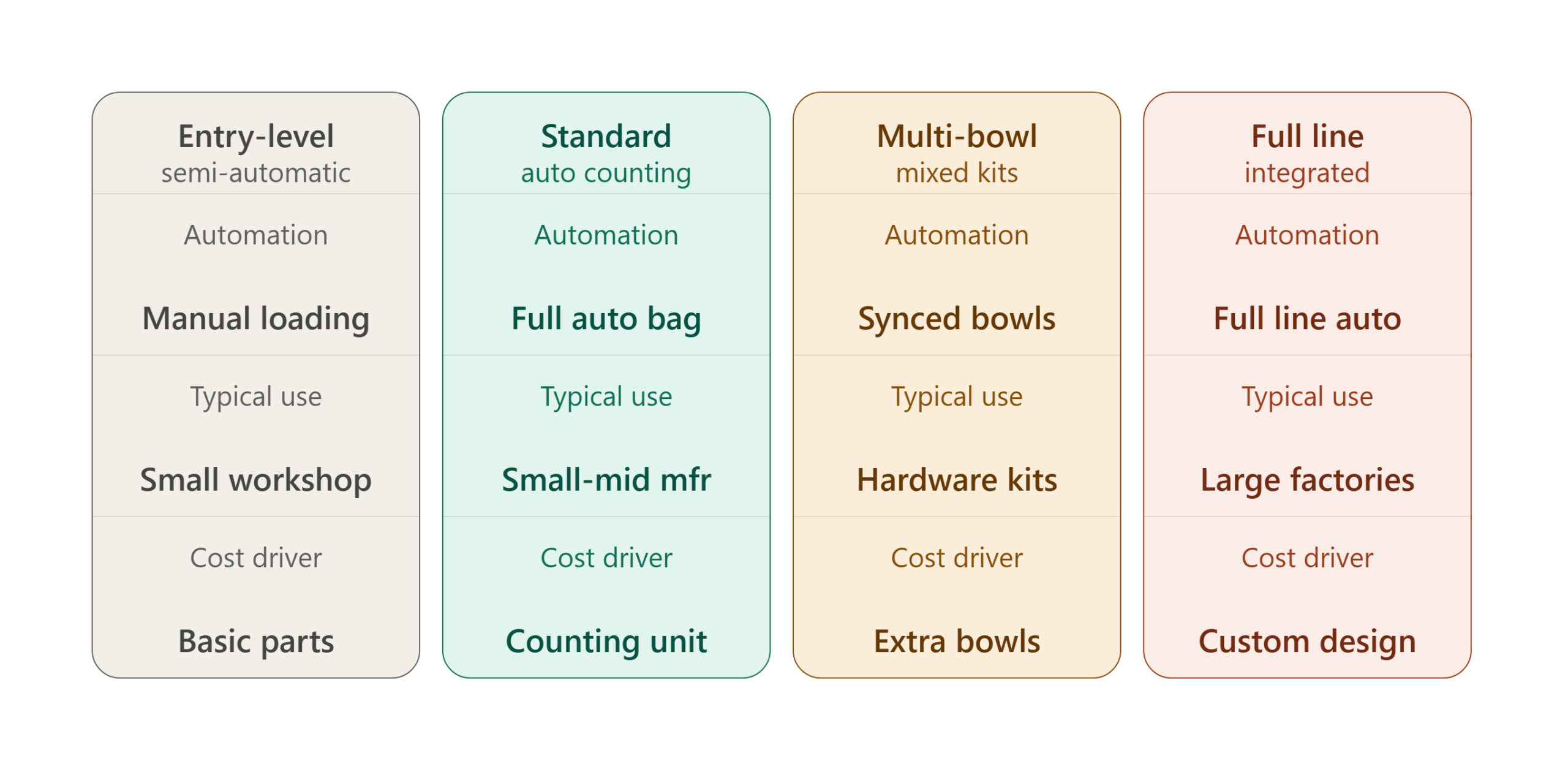
Entry-level semi-automatic counters These handle counting only, with a worker manually loading and bagging. They suit low-volume workshops or businesses just automating their first process. This is the lowest-cost entry point into automated counting, but throughput and consistency are limited by the manual steps still involved.
Standard automatic counting and bagging machines This is the most common configuration for small-to-mid-size fastener distributors and hardware manufacturers — a single-bowl or multi-bowl vibratory counter integrated with an automatic bag-making and sealing unit. This tier covers the bulk of the market and is where most first-time automation buyers land.
Multi-bowl mixed-kit packaging systems For businesses that need to pack multiple different components into one bag (for example, furniture hardware kits with screws, dowels, and brackets together), the machine needs multiple synchronized counting bowls, a control system that manages different part shapes, and often a “weighing + remainder-filling” mechanism to keep high-volume runs accurate. This added complexity moves the price up meaningfully compared to single-material machines.
Fully integrated production lines For large manufacturers or brand-name clients running high-volume, 24/7 packaging (automotive kitting, retail-scale fastener packing, factory-to-warehouse automation), the “machine” becomes a full line: automatic feeding, multi-station counting, boxing or cartoning, labeling, and sometimes robotic palletizing. These are custom-engineered projects, priced closer to a capital equipment investment than a single machine purchase.
Because exact figures shift with raw material costs, component brands, and currency, we’re intentionally not quoting fixed numbers here — the more useful exercise is understanding what moves you between these tiers, which is what the next section covers.
What Actually Drives the Price
1. Counting technology This is one of the most misunderstood factors in pricing, and it’s worth getting right before you compare quotes.
- Fiber-optic counting is generally the most reliable and cost-effective choice for the screw, fastener, and hardware packaging industry, with accuracy that can reach 99.99%. Its main limitation is a ceiling on counting speed — it will not match CCD vision counting for sheer throughput, but for most fastener packaging applications, its accuracy and consistency make it the preferred technology.
- CCD vision counting is genuinely fast, but that speed comes with trade-offs that are easy to underestimate. It requires ongoing calibration for each new material — every different part shape or size needs to be “taught” to the system before it counts accurately, and real-world accuracy often runs closer to 85% until that calibration is dialed in. Switching between materials frequently means repeating this calibration each time, which adds a real learning curve and operator training cost.
- Basic mechanical or photoelectric counting is the lowest-cost option but the least accurate at high speed, and is best suited to lower-volume or less demanding applications.
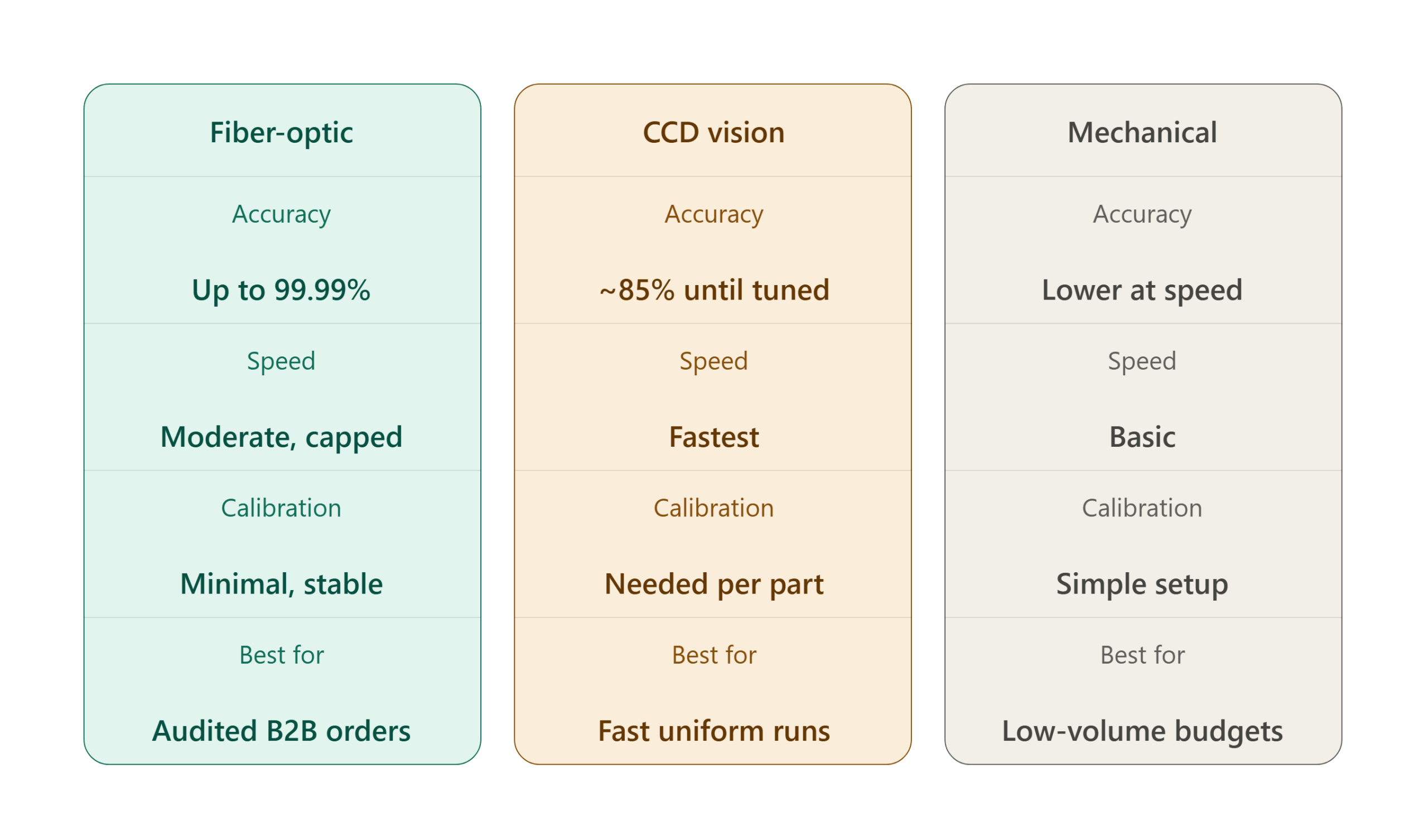
For B2B buyers whose customers audit counts on arrival, the practical choice is usually fiber-optic counting: slightly slower than CCD, but far more consistent and far less dependent on constant recalibration — which matters more than raw speed once you factor in real operating conditions.
2. Number of materials and bowls A single-material counter is the cheapest configuration. Every additional material type (mixed kits — screws + washers + nuts, for example) adds a bowl, more sensors, and more complex control logic, which increases both hardware and engineering cost.
3. Output speed and daily volume Machines built for 20 bags per minute cost more than machines built for 5 bags per minute, even with similar counting technology, because of stronger drive systems, faster valves, and higher-grade components.
4. Packaging format Simple bag-and-seal is the cheapest format. Boxing, cartoning, or combined bagging-and-boxing lines require additional mechanical stations and cost more.
5. Level of customization A standard, catalog-configuration machine is less expensive than a fully custom design built around your specific part geometry, bag size, or factory layout. If your components are irregular in shape (non-standard fasteners, plastic clips, small hardware with tight tolerances), expect a customization premium for R&D and tooling.
6. Automation and controls PLC-based systems with touchscreen HMI, automatic fault detection, and remote diagnostics cost more than basic control panels, but they reduce downtime and make training new operators faster — worth weighing against the sticker price.
7. After-sales support and certification Machines built to CE, ISO, or TÜV standards, backed by a supplier offering installation support, spare parts availability, and long-term technical service, typically carry a higher price than uncertified machines from smaller workshops. For many international buyers, this is not optional — it is a requirement for import compliance and long-term reliability.
Thinking About Cost as ROI, Not Just Price
The purchase price is only half the story. The more useful question for most buyers is: how fast does this machine pay for itself?
To estimate that, look at:
- Labor cost saved — how many manual counting/packing workers does the machine replace or free up for other tasks?
- Error and shortage reduction — miscounts lead to customer complaints, returns, and rework. Higher-accuracy counting reduces this cost, which is often underestimated when budgeting.
- Throughput gain — a machine that lets you fulfill larger orders or meet tighter shipping deadlines can directly translate into revenue, not just cost savings.
- Uptime — a cheaper machine that breaks down frequently, or one from a supplier without local after-sales support, can cost more over its lifetime than a slightly pricier, more reliable one.
Many buyers find that a mid-tier automatic counting and bagging machine pays for itself within a year or two through labor savings alone, before even accounting for reduced errors and faster order fulfillment — though the exact payback period depends heavily on your current labor costs and production volume.
Questions to Ask Before You Get a Quote
To get an accurate, comparable quote from any supplier, be ready to answer:
- What part(s) are you counting/packaging (material, size, shape)?
- Do you need single-material or multi-material (kit) packaging?
- What is your target output — bags per minute, or units per shift?
- What packaging format do you need — bag only, box only, or combined?
- What accuracy level does your customer or industry require?
- Do you need CE/ISO/TÜV certification for import into your market?
- What is your available floor space and power supply?
Suppliers who ask you these questions before quoting a price are giving you a real, workable estimate. Suppliers who quote a number with no questions asked are usually quoting a generic base unit — the real cost will move once your actual requirements are added.
Getting an Accurate Quote
Because so much of the price depends on your specific parts, volume, and packaging format, the most reliable way to budget is to share your requirements with a manufacturer directly and request a tailored quote rather than relying on a general price range. A good supplier will walk through your part specifications, expected output, and packaging goals, and come back with a configuration — and price — built around your actual production needs, not a generic catalog number.
If you’d like a free, no-obligation quote for your specific screws, fasteners, or hardware components, reach out with your part details and target output, and we’ll put together a configuration and cost estimate tailored to your line.