







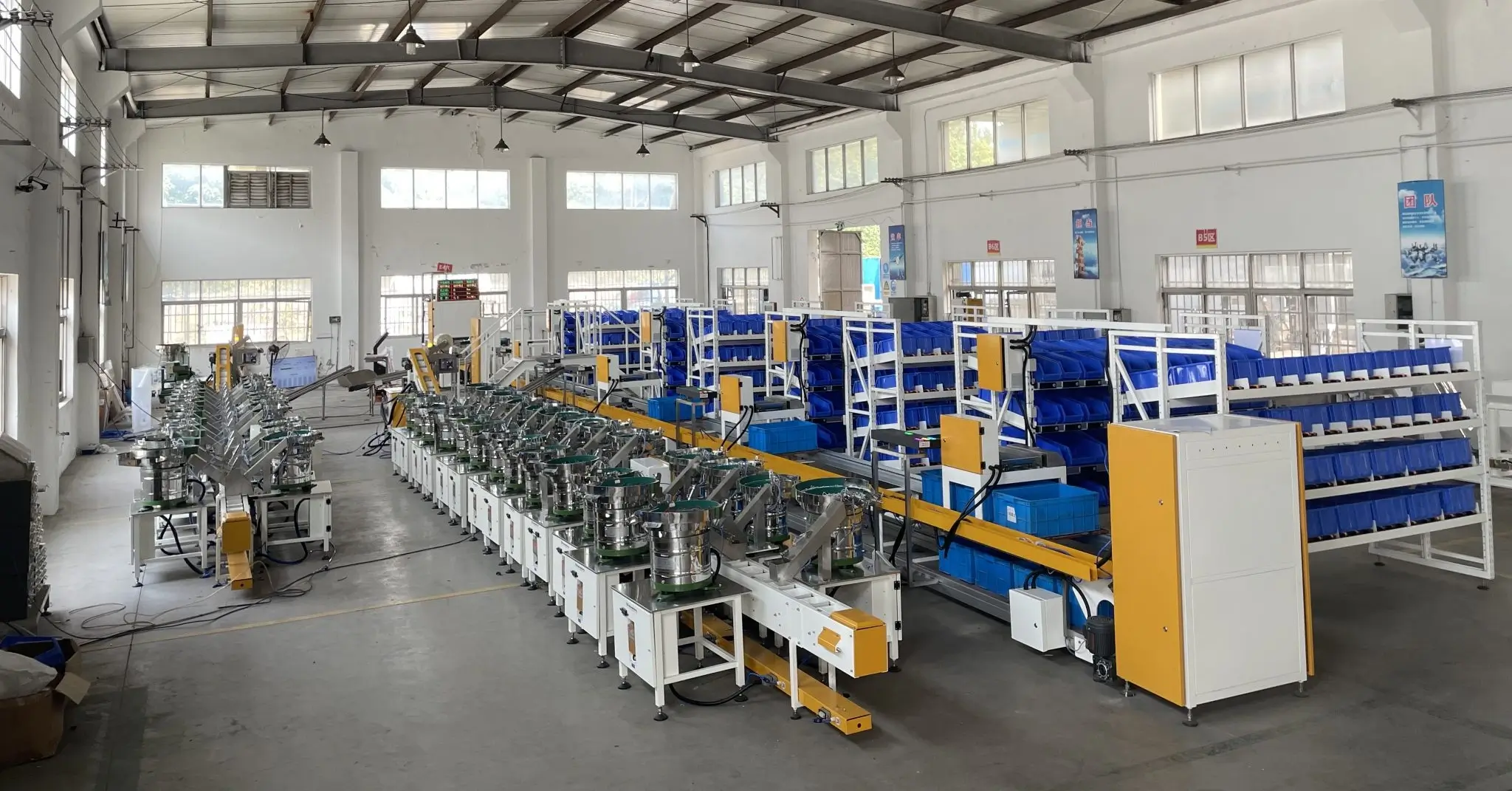
In the global manufacturing ecosystem, screws, fasteners, hardware components, and furniture accessories appear to be simple products. However, behind every small metal component lies a complex supply chain challenge: how to achieve accurate counting, flexible packaging, and stable delivery at industrial scale.
For decades, many manufacturers relied on manual counting and semi-automatic packaging processes. Workers manually counted screws, sorted hardware components, filled bags, and sealed packages. This approach may appear inexpensive from a short-term perspective, but under modern manufacturing conditions, the hidden costs have become increasingly obvious:
- High labor dependency
- Human counting errors
- Low production consistency
- Difficulty managing multiple specifications
- Poor traceability
- Limited scalability
For companies producing thousands or even millions of hardware kits every day, manual operations are no longer a competitive advantage. They have become a bottleneck restricting productivity and quality control.
Traditional standard packaging machines solved part of the problem by improving bag making, sealing, and basic weighing functions. However, they often struggle when facing real industrial requirements:
- Different screws packed together in one bag
- Multiple fastener combinations for assembly kits
- Small hardware components with different shapes and weights
- Frequent product changeovers
- Customized packaging requirements from global customers
This is where the industry enters a new stage: the transition from standardized packaging equipment to customized intelligent automation systems.
The competition is no longer about who can manufacture a cheaper packaging machine. The real competition is about who can provide a complete solution combining:
automatic counting + sorting + feeding + bag making + sealing + ERP integration + customized production management.
The Screw Packaging Machine industry is undergoing a fundamental transformation. The future belongs to manufacturers who understand the manufacturing process behind the product, not simply those who assemble mechanical components.
1. From Standard Machines to Non-Standard Automation: The New Industrial Reality
1.1 The manufacturing industry is demanding flexibility, not only speed
The fastener and hardware industries have traditionally operated under a high-volume production model. A manufacturer produces one specification, packages it, and ships it.
However, downstream industries are changing.
Automotive manufacturers, furniture companies, electrical equipment producers, and industrial assembly companies increasingly require:
- More product varieties
- Smaller batch sizes
- Faster delivery cycles
- Zero-error assembly kits
- Digital production traceability
A furniture manufacturer, for example, may require a package containing:
- 12 screws of type A
- 8 screws of type B
- 4 nuts
- 2 special plastic components
The challenge is not simply putting products into bags. The challenge is ensuring that every package contains the correct combination of components.
A missing screw may delay an assembly line. A wrong quantity may create quality issues downstream. In industries with strict supply chain management, packaging accuracy directly influences customer satisfaction and production efficiency.
Therefore, modern hardware packaging is becoming a critical manufacturing process rather than a simple logistics operation.
1.2 The rise of customized Screw Counting and Packaging Machine solutions
A modern Screw Counting and Packaging Machine is no longer a single-purpose device.
It is becoming an integrated automation platform including:
- Vibratory bowl feeding systems
- Fiber-optic counting technology
- Precision sorting mechanisms
- Automatic bag making systems
- Heat sealing units
- Weight verification systems
- Production data management
- ERP integration capability
This evolution reflects a deeper industrial trend:
Manufacturers are moving from equipment purchasing to solution purchasing.
They are not asking:
“Can your machine pack screws?”
They are asking:
“Can your system guarantee that every package is correct, traceable, flexible, and economically sustainable for the next five years?”
This difference defines the gap between traditional machinery suppliers and automation solution providers.
2. Demand-Side and Supply-Side Analysis: Why the Market Is Separating
2.1 Global customers are raising the standard of packaging automation
Large industrial supply chains have already established extremely high requirements for packaging accuracy.
Companies such as global fastener distributors, automotive suppliers, and furniture hardware manufacturers require suppliers to provide:
- Stable delivery
- Consistent quality
- Reduced manual intervention
- Faster product switching
- Complete production records
For companies operating globally, packaging is not an isolated process. It is connected with:
- Warehouse management
- Inventory control
- Production scheduling
- Customer delivery systems
This creates demand for intelligent Fastener Packaging Machine solutions.
A supplier who only provides a mechanical packaging device cannot satisfy these requirements.
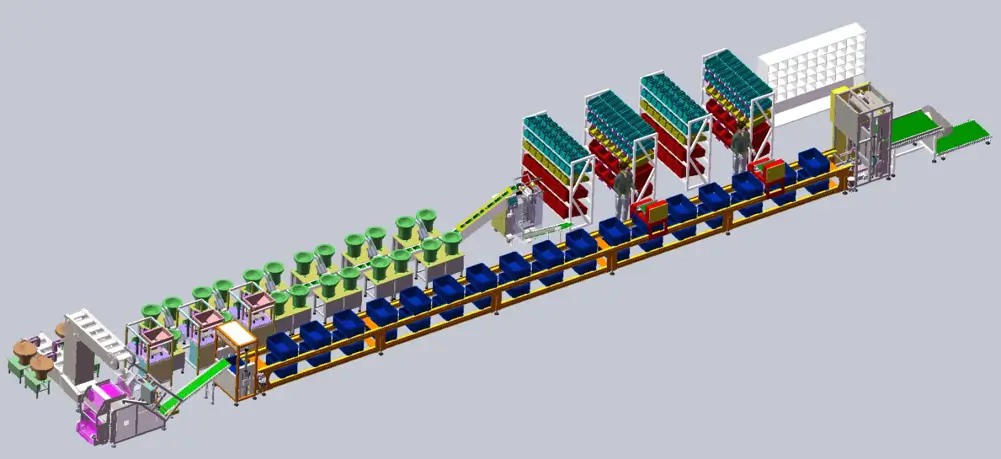
The future requirement is a complete ecosystem:
Material feeding → Accurate counting → Sorting → Packaging → Sealing → Inspection → Data management
2.2 Why many suppliers remain trapped in low-end competition
Despite strong market demand, many packaging machine manufacturers remain focused on price competition.
The reason is simple:
Basic packaging structures are relatively easy to copy.
A machine frame, sealing mechanism, and standard controller can be replicated quickly. This creates a large number of similar-looking products in the market.
However, the real technical barriers are hidden inside the system.
For example:
Multi-bowl synchronization technology
When multiple screws or hardware components need to be packed together, each feeding system must operate independently while maintaining synchronization.
Challenges include:
- Different component shapes
- Different feeding speeds
- Different vibration characteristics
- Avoiding material blockage
- Maintaining counting accuracy
This requires years of practical engineering experience.
Complex vibratory bowl feeding control
The vibratory bowl is not simply a feeding container.
It is a precision separation system.
Different products require different solutions:
- Screw length variation
- Head shape differences
- Surface treatment differences
- Weight differences
- Material friction differences
A well-designed vibratory bowl determines whether the entire system can operate continuously.
Fiber-optic counting precision
For small hardware components, counting accuracy is the core technology.
Fiber-optic sensors provide:
- High-speed response
- Strong environmental resistance
- Reliable detection of small objects
- Stable operation in industrial environments
Compared with simple mechanical counting methods, fiber-optic counting provides a higher level of precision and repeatability.
This is one of the reasons why advanced Screw Packaging Machine systems increasingly adopt fiber-optic counting technology.
3. Technology Route Competition: Why Fiber-Optic Counting + Weighing Is Becoming the Optimal Solution
In recent years, artificial intelligence vision technology has attracted significant attention in industrial automation. Many companies have attempted to introduce cameras and AI algorithms into hardware counting applications.
At first glance, vision counting appears to be an advanced solution:
- Camera recognition
- AI image processing
- Object classification
- Automatic quantity detection
However, when applied to real-world bulk hardware packaging environments, the limitations become increasingly obvious.
The question is not whether AI vision can recognize screws.
The real question is:
Can AI vision maintain industrial-level accuracy, stability, and economic efficiency under continuous high-speed production conditions?
The answer depends heavily on the application scenario.
3.1 The hidden challenges of AI vision counting systems
Unlike products placed neatly on a conveyor belt, screws and fasteners are chaotic bulk materials.
They have several characteristics:
- Random orientation
- Overlapping conditions
- Reflective metal surfaces
- Similar appearance between different models
- High-speed movement
- Dust and vibration interference
These factors create significant challenges for vision algorithms.
For example, when hundreds of screws move simultaneously through a feeding system:
- Two screws may overlap
- One screw may block another
- Reflections may confuse recognition
- Different surface finishes may change image characteristics
Even advanced AI models must continuously process complex image variations.
This creates several practical problems:
1. Higher equipment cost
A reliable industrial vision system requires:
- Industrial cameras
- Lighting systems
- Image processors
- AI algorithms
- Software maintenance
The investment can be significantly higher than traditional sensing solutions.
2. Higher maintenance requirements
Industrial environments are different from laboratory environments.
Factories experience:
- Vibration
- Temperature variation
- Dust accumulation
- Mechanical movement
A vision system requires regular calibration and maintenance.
Any small change in lighting conditions or camera position may affect accuracy.
3. The “false intelligence” problem
Many customers assume AI automatically means higher precision.
However, industrial automation follows a different principle:
The best technology is not the most advanced technology. The best technology is the one that delivers the highest reliability under total cost consideration.
For high-volume screw and hardware packaging applications, stability is often more valuable than technological complexity.
3.2 Fiber-optic counting + weighing: The industrially optimized solution
For decades of industrial practice, fiber-optic counting technology has proven highly suitable for small hardware packaging.
A professional Screw Counting and Packaging Machine typically combines:
- Vibratory bowl feeding
- Fiber-optic counting
- Weight verification
- Intelligent control system
This hybrid approach creates multiple layers of accuracy.
Layer 1: Precision counting
Fiber-optic sensors detect each individual component passing through the feeding channel.
Advantages:
- Extremely fast response
- Accurate detection of small components
- Stable performance
- Strong resistance to environmental interference
Whether counting:
- Screws
- Bolts
- Nuts
- Washers
- Plastic parts
- Electronic components
the system can maintain consistent accuracy.
Layer 2: Weight verification
Counting technology provides quantity control.
However, weighing technology provides another verification layer.
The system can detect:
- Missing components
- Incorrect quantity
- Abnormal feeding conditions
This combination significantly improves reliability.
Layer 3: Production intelligence
Modern customized packaging systems can also connect with factory management systems.
Through ERP integration, manufacturers can achieve:
- Production tracking
- Order management
- Packaging data recording
- Batch traceability
This transforms packaging equipment from a standalone machine into a connected manufacturing unit.
4. The Birth and Evolution of Multi-Bowl Mixed Packaging Technology
The development of customized multi-material packaging systems did not happen overnight.
In China, early exploration of non-standard multi-bowl mixed packaging technology began around 2008.
Companies represented by Shanghai Feiyu Packaging Machinery entered this field when the market was still dominated by traditional manual packaging and basic weighing machines.
At that time, the challenge was clear:
How can multiple types of small hardware components be automatically counted, sorted, and packed into one package with high reliability?
The answer required breakthroughs in:
- Multi-vibratory bowl coordination
- Feeding accuracy control
- Fiber-optic counting algorithms
- Mechanical customization capability
- Packaging process integration
This represented a fundamental shift from selling machines to delivering manufacturing solutions.
Over the following years, the industry experienced a process of differentiation.
Many companies entered the market by copying external structures. However, without deep engineering experience, they often struggled with:
- Unstable feeding
- Frequent downtime
- Difficult product changeovers
- Poor counting accuracy
The market gradually separated into two categories:
Low-cost equipment assemblers and technology-driven automation solution providers.
This separation continues today.
5. The Trap of Industry Price Wars: Why Low-Cost Customization Often Fails
The fastener packaging industry faces a common problem across manufacturing sectors:
The misunderstanding of customization.
Many buyers believe customization simply means modifying machine dimensions or adding several components.
This is not true.
Real customization requires understanding:
- Product characteristics
- Material behavior
- Production rhythm
- Packaging requirements
- Future expansion possibilities
A true customized Fastener Packaging Machine is the result of engineering analysis.
5.1 The danger of “pseudo-customization”
Some suppliers offer extremely low prices by using:
- Standard machine structures
- Simple modifications
- Low-cost electrical components
- Limited testing
The machine may operate during factory acceptance testing.
However, after installation, problems appear:
- Frequent material jams
- Incorrect counting
- Slow changeover
- Excessive operator intervention
- Difficult maintenance
The initial purchase price may look attractive.
But the real cost is determined by Total Cost of Ownership (TCO).
A cheaper machine that causes production interruptions can become much more expensive over a five-year operating cycle.
5.2 Industrial customers are moving toward lifecycle value
Professional buyers increasingly evaluate equipment through:
Equipment reliability
Can the machine operate continuously?
Production efficiency
Can it reduce labor dependency?
Flexibility
Can it handle future product changes?
Service capability
Can technical support solve problems quickly?
The winning supplier is not necessarily the cheapest.
It is the supplier who reduces long-term operational risk.
6. Future Trends: The Next 3-5 Years of Screw Packaging Automation
The next stage of the industry will be defined by three major trends.
6.1 From automation equipment to intelligent manufacturing systems
Future Screw Packaging Machine solutions will integrate more digital capabilities:
- ERP integration
- MES connection
- Remote monitoring
- Production analytics
- Automatic parameter management
Packaging machines will become part of the smart factory ecosystem.
6.2 Global supply chains will accelerate demand for customized solutions
Manufacturing is becoming increasingly distributed.
North America, Southeast Asia, and emerging industrial regions are attracting more production investment.
These factories need:
- Flexible automation
- Reduced labor dependence
- Reliable suppliers
- Easy operation systems
This creates new opportunities for Chinese automation manufacturers with strong engineering capabilities.
6.3 Technology-driven companies will build stronger barriers
In the future, competition will not depend only on manufacturing capacity.
The strongest companies will combine:
- Mechanical engineering
- Automation software
- Industrial experience
- Application knowledge
- Global service capability
The real competitive advantage is accumulated engineering knowledge.
A packaging machine can be copied.
But decades of solving thousands of industrial applications cannot be copied.
Conclusion: The Future Belongs to Precision, Flexibility, and Engineering Capability
The evolution of the Screw Packaging Machine industry reflects a broader transformation in global manufacturing.
The market is moving away from:
- Manual operation → intelligent automation
- Standard machines → customized systems
- Price competition → lifecycle value competition
For screws, hardware, and fasteners, the core challenge is not simply packaging.
It is achieving:
accurate counting, reliable sorting, efficient bag making, stable sealing, and flexible customization under real industrial conditions.
Technologies such as:
- Fiber-optic counting
- Multi-bowl vibratory feeding
- Automatic sorting systems
- Weighing verification
- ERP integration
are becoming the foundation of next-generation Fastener Packaging Machine solutions.
Manufacturers that understand this transformation will become strategic partners for global supply chains.
Those who remain focused only on low-cost equipment will increasingly face market pressure.
The future of industrial packaging belongs to companies capable of combining engineering depth, automation innovation, and customer-specific solutions.
About Shanghai Feiyu Packaging Machinery
Shanghai Feiyu Packaging Machinery specializes in customized automatic packaging solutions for screws, fasteners, hardware components, and industrial small parts.
With extensive experience in Screw Counting and Packaging Machine development, Feiyu provides solutions including:
- Automatic screw counting packaging machines
- Multi-bowl fastener packaging systems
- Hardware sorting and packing equipment
- Customized vibratory bowl feeding solutions
- Fiber-optic counting packaging technology
- Integrated weighing and ERP-connected packaging systems
By focusing on precision engineering and industrial reliability, Feiyu helps manufacturers worldwide improve packaging efficiency, reduce labor dependency, and build smarter production systems.